Background & Challenge
Clear communication is essential for safe and high-quality healthcare. Deaf and hard-of-hearing patients, however, often face significant barriers in medical consultations, particularly during history-taking, symptom description, and the explanation of diagnoses and treatments (Tannenbaum‐Baruchi et al., 2025). Limited access to sign language, complex medical terminology, and time pressure in general practice settings frequently result in misunderstandings, frustration, and reduced patient autonomy (Lee & Munoz-Cornejo, 2025).
Project Approach
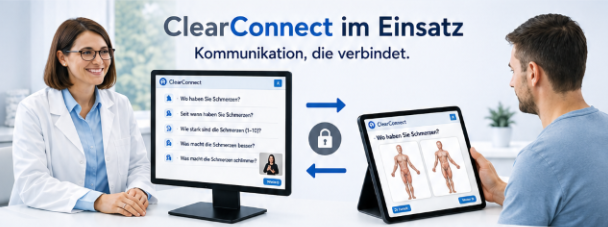
ClearConnect explores a tablet-based, visually supported communication system designed specifically for use in general practitioner practices. The project follows a user-centred design approach, combining literature research with qualitative field studies involving deaf and hard-of-hearing patients, Austrian Sign Language (ÖGS) interpreters, and general practitioners. The goal was to understand real-world communication breakdowns and translate these insights into concrete design requirements.
Concept & Solution
The proposed system enables patients to express symptoms, pain levels, and emotional states using clear icons, simplified text, and sign-language-supported visuals. Physicians receive a structured overview of patient input, allowing them to prepare and conduct consultations more efficiently. The interface is designed to be intuitive, accessible, and compatible with time-pressured clinical workflows.
Outcome & Vision
The project results in a low- to mid-fidelity prototype demonstrating multimodal communication and accessibility-focused interaction design. ClearConnect aims to support inclusive, respectful, and efficient communication in healthcare while complementing—rather than replacing—professional interpreting services.
First Impression
For a more comprehensive understanding of our project, we invite you to visit our website www.clearconnect.at. The website offers additional information about ClearConnect, including the problem we address, how the solution works and key features. It serves as a first point of contact for anyone interested in learning more about our approach to accessible and inclusive communication in healthcare.
References
- Lee J, Munoz‑Cornejo G. The impact of healthcare digitalization on communication with healthcare providers: the case of people who are hard of hearing. Health Commun. 2025;40(9):1851‑1861. doi:10.1080/10410236.2024.2426855.
- Tannenbaum‑Baruchi C, Feder‑Bubis P, Aharonson‑Daniel L. Communication barriers to optimal access to emergency rooms according to deaf and hard‑of‑hearing patients and health care workers: a mixed‑methods study. Acad Emerg Med. 2025;32:246‑259. doi:10.1111/acem.15037.
Project Team
- Veronika Ehrenberger, BSc
- Benjamin Jungwirth, BSc
- Angelina Schuber, BSc
- Ina Faltner, BSc
- Laurenz Engel, BA
- Tanja Elser, BSc
Coach
Dipl.-Ing. David Feilacher, BSc
A Project at the St. Pölten University of Applied Sciences
Master Program Digital Healthcare
Contact
Mail: team@clearconnect.at
LinkedIn: Clear Connect