
From Triage to Navigation: Rapid Emergency Triage and Treatment System (RETTS)-Based Digital Patient Referral in Austrian Prehospital Care
Aim and Research Question(s)
Austria's EMS and emergency departments face increasing pressure from non-urgent patients. This thesis examines RETTS' potential in the Austrian prehospital context and explores how a digital allocation tool can support structured patient referral. Two research questions guided the study: RQ1 examines how RETTS can be adapted and implemented in the Austrian EMS to support effective coordination between acute and community care. RQ2 investigates how RETTS supports clinical decision-making and improves communication between emergency and community care providers.
Background
Austria's non-gatekeeping system leads to frequent ED misuse for non-urgent conditions. [1] Around two-thirds of ambulance-transported patients are not high-priority emergencies and approximately 20% of subsequent hospital admissions are considered avoidable. [2]. RETTS combines vital signs assessment with symptom-based ESS algorithms [3] and has been integrated into Red Cross Lower Austria (Mödling) prehospital protocols since late 2025. Existing Austrian navigation tools lack urgency-based referral functionality. A gap this thesis addresses. [4]
Methods
A mixed-methods design was applied: a scoping review across PubMed, ScienceDirect and Google Scholar (Nov 2025 – Apr 2026); an online survey (n = 15) among certified Red Cross paramedics adapted from Wireklint et al. [5], analysed with descriptive statistics and qualitative content analysis [6]; and development of the VersorgungsNavigator, a web-based prototype linking RETTS ESS codes to regional providers.
Results and Discussion
The survey (response rate 68.2%) showed that RETTS is primarily used for home discharge decisions. 14/15 respondents reported improved legal safeguarding and 13/15 greater confidence in home discharge decisions. However, 8 respondents found RETTS not intuitive. Key barriers included time pressure (n=10), insufficient training (n=8) and lack of hospital acceptance (n=6). The absence of communication improvement reflects lacking adoption across prehospital and hospital settings. The VersorgungsNavigator demonstrates technical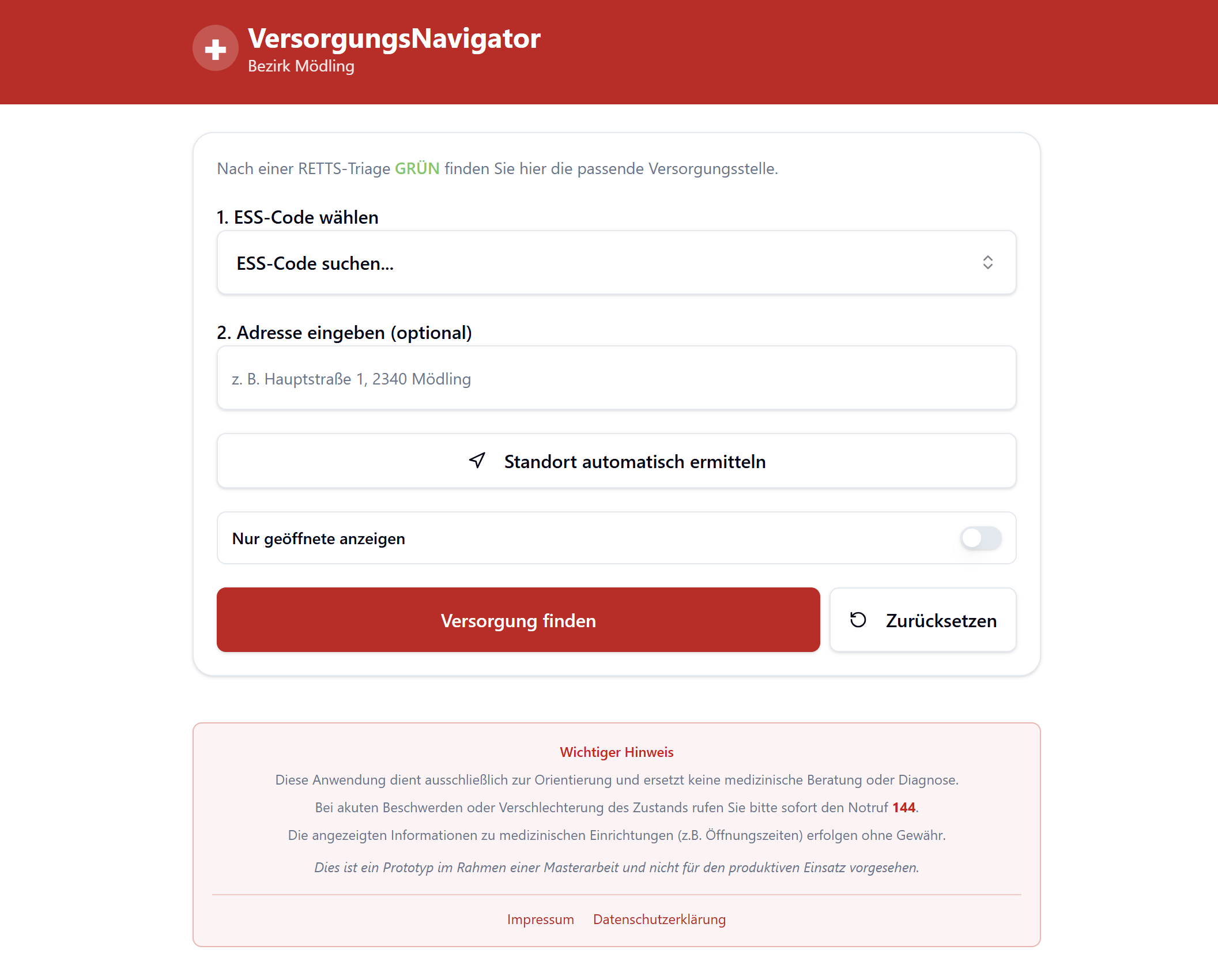 feasibility of triage-informed digital patient navigation within the Austrian context as shown by the start page of the web application in the image.
Conclusion
RETTS shows strong potential for prehospital decision support in Austria, especially for legal safeguarding. Full communication benefits require coordinated implementation across all care settings. Future work should prioritise usability improvements, simulation-based training and national legal frameworks for non-conveyance decisions.
References
[1] K. Hoffmann et al., "The influence of general practitioners on access points to health care in a system without gatekeeping," Croatian Medical Journal, 2019. [2] Arbeiterkammer Wien, "Sanitäter:innen – Schlüsselrolle im Gesundheitssystem," 2026. [3] C. Magnusson, "Patient assessment and triage in emergency medical services," PhD thesis, University of Gothenburg, 2021. [4] A. Ramssl-Sauer et al., "Userbefragung zum Gesundheitsportal gesundheit.gv.at 2024," GÖG, 2025. [5] C. Wireklint et al., "Triage practices in Swedish emergency departments," Emergency Medicine Journal, 2021. [6] P. Mayring, Qualitative Inhaltsanalyse, 13th ed., 2022.