
Development and Initial Validation of a Motion Capture-Based Sit-to-Stand Score to Differentiate Patients with Knee Osteoarthritis from Healthy Individuals
Aim and Research Question(s)
To develop and initially validate a motion capture-based Sit-to-Stand Profile Score (STSPS). The study examined whether the STSPS differentiates individuals with knee osteoarthritis (KOA) from healthy controls (HCs), which biomechanical parameters characterize STS performance, and whether the score is transferable from marker-based to markerless motion capture.
Background
Clinical sit-to-stand tests primarily assess completion time or repetition count and provide limited information on movement quality [1]. Composite scores can summarize multidimensional kinematic data [2], but an established STS-specific score is lacking.
Methods
This exploratory cross-sectional study included 15 participants with KOA and 15 HCs. During the 30-Second Chair Stand Test, movement was recorded simultaneously using Vicon and OpenCap [3].
For ten kinematic parameters of the rising phase, deviations from HC reference trajectories were quantified and aggregated into six STSPS variants. Group discrimination was assessed using statistical tests and ROC analysis. Transferability between systems was examined using correlation, ICC, and Bland–Altman analysis.
Results and Discussion
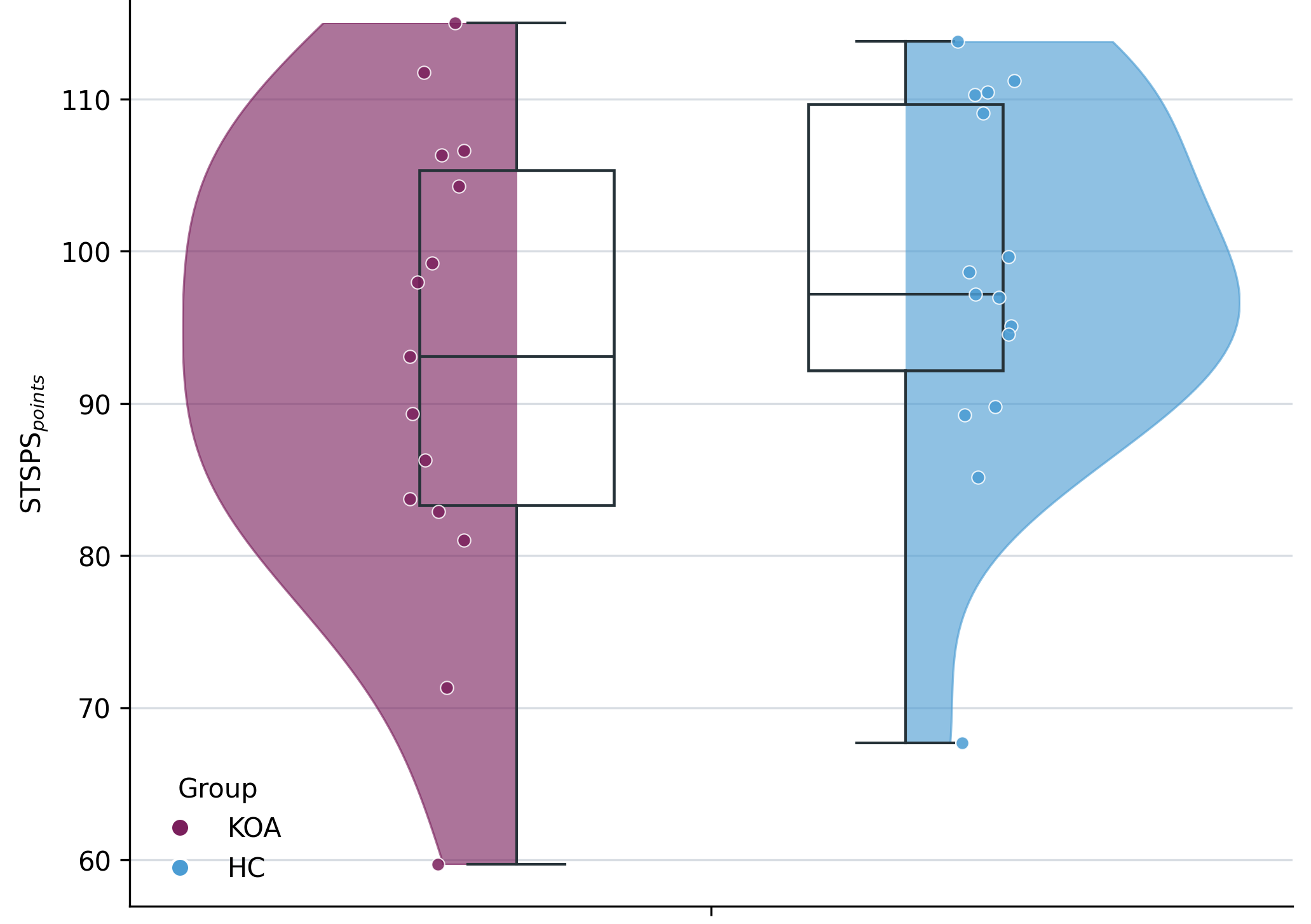
No STSPS variant differed significantly between groups; AUCs ranged from 0.36 to 0.61. For STSPSpoints, KOA participants scored 92.57 ± 15.49 compared with 97.92 ± 12.27 in HCs (p = .303). The substantial overlap shown in Figure 1 indicates limited discrimination.
Variable-specific profiles were heterogeneous and showed no consistent KOA-specific pattern. Vicon- and OpenCap-derived STSPSpoints values were positively associated (r = .69) and showed moderate agreement (ICC = .68), but were not interchangeable at the individual level.
Limited discrimination may reflect the small sample, mild functional impairment, inter-individual variability, bilateral averaging, and equal parameter weighting.
Conclusion
The STSPS was feasible to calculate but did not sufficiently distinguish KOA from HCs. Future studies should use larger, functionally heterogeneous samples and evaluate variable-specific profiles against functional outcomes.
References
[1] G. Frykberg and C. Hager, “Movement analysis of sit-to-stand – research informing clinical practice,” Phys. Ther. Rev., 2015.
[2] R. Baker et al., “The Gait Profile Score and Movement Analysis Profile,” Gait Posture, 2009.
[3] S. D. Uhlrich et al., “OpenCap: Human movement dynamics from smartphone videos,” PLOS Comput. Biol., 2023.