
Design of a Prototype Digital Twin Framework for Personalized Nutrition in Prediabetes and T2D (Type 2 Diabetes) in Dietetic Practice
Aim and Research Question(s)
The aim of this master thesis was to design a conceptual Digital Twin prototype framework for dietitians and individuals with prediabetes and type 2 diabetes (T2D) and to explore its potential use in dietetic practice. Research Questions: RQ1: How can multidimensional health data be integrated into a practical and understandable conceptual digital twin prototype framework for dietitians and individuals with prediabetes and T2D? RQ2: Which visualization and feedback features are perceived as suitable for helping dietitians and individuals with prediabetes and T2D understand and interpret the integrated data in a meaningful way? RQ3: What are the opportunities and barriers to implementing a conceptual Digital Twin prototype framework in dietetic practice for individuals with prediabetes and T2D?
Background
Prediabetes and T2D are major public health challenges [1]. Although increasing amounts of health data are available, these data often remain fragmented, require manual documentation, and are not meaningfully connected or intuitively visualized for everyday use. Digital Twin technologies offer the potential to integrate different types of individual health data.
Methods
First, a narrative literature review was conducted to identify relevant Digital Twin concepts, health data dimensions, and approaches to personalized nutrition and diabetes management [2,3]. Second, based on these findings, the conceptual prototype myNutriTwin was designed [6]. Third, semi-structured interviews were conducted with six participants: two dietitians, two individuals with prediabetes, and two individuals with T2D. The data were analyzed using qualitative content analysis according to Mayring and Kuckartz [4,5].
Results and Discussion
Participants valued the shared overview of myNutriTwin with clear dashboard, trends, simulations, and personalized feedback for data interpretation. Dietitians emphasized support for counseling and follow-up, while individuals with prediabetes and T2D prioritized motivation and everyday usability. Perceived opportunities included better disease understanding and shared decision-making. Barriers included time, manual data entry, costs, information overload, and privacy concerns. These exploratory findings suggest potential to support dietetic practice, while further evaluation with a larger sample is needed.
Conclusion
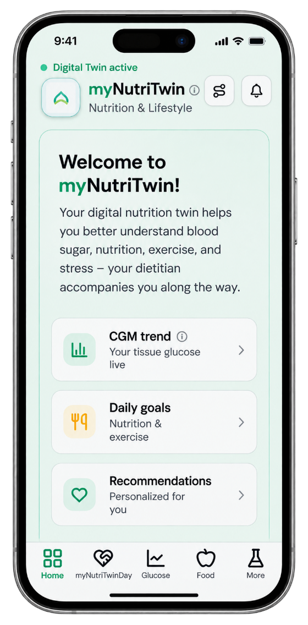 Qualitative findings suggest that the myNutriTwin prototype has potential to support dietetic practice for individuals with prediabetes or T2D through integrated visualizations and feedback. The conceptual prototype provides a basis for further development, with broader usability testing and technical implementation as possible next steps.
References
[1] IDF. (2025). Diabetes Atlas. [2] Renner et al. (2023). Adv Nutr, 14(5), 983–994. [3] Katsoulakis et al. (2024). npj Digit Med, 7, 77. [4] Kuckartz. (2018). Qualitative Inhaltsanalyse. 4. Aufl., Beltz Juventa. [5] Mayring. (2015). Qualitative Inhaltsanalyse. 12. Aufl., Beltz. [6] Sedlmair et al. (2012). IEEE Trans Vis Comput Graph, 18(12), 2431–2440.