
Expert Input and Prototyping for a Just-in-Time Adaptive Intervention to Support Nursing Students’ Stress and Well-Being
Aim and Research Question(s)
- Which stress situations, constraints and support needs do nursing students and nurses identify?
- Which decision points, tailoring variables, intervention options and decision rules can be derived?
- How do nursing students rate the prototype's usability, usefulness, acceptability and contextual fit?
Background
Nursing students' stress peaks during clinical placements [1], and mental health apps are often abandoned quickly [2]. Just-in-Time Adaptive Interventions (JITAIs) adapt support to a person's current state and context [3], but no reviewed source described one for nursing students.
Methods
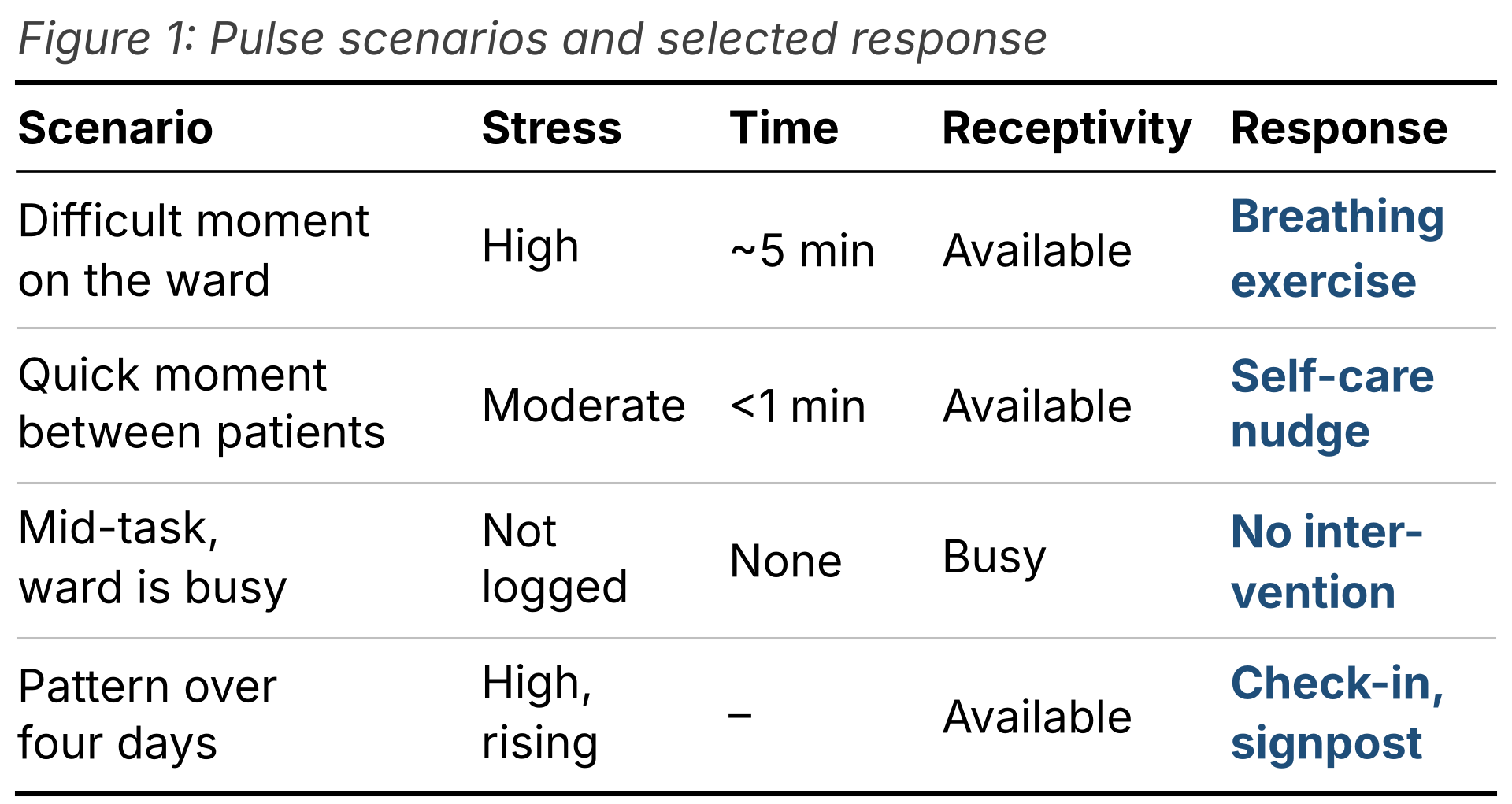
Interviews with two nursing students and two mentoring nurses (n = 4; qualitative content analysis [4]) revised a literature-based Decision Logic Framework, implemented as Pulse, a four-scenario walkthrough (Figure 1). Nursing students from three Austrian universities of applied sciences (33 datasets) rated it with the System Usability Scale (SUS) [5], six adapted Technology Acceptance Model (TAM) items [6] and open questions.
Results and Discussion
Stress level alone was not enough: time and social visibility (being watched by others) also shaped the response. The framework has 4 decision points, 7 tailoring variables, 8 decision rules and 5 intervention options (incl. “no intervention”).
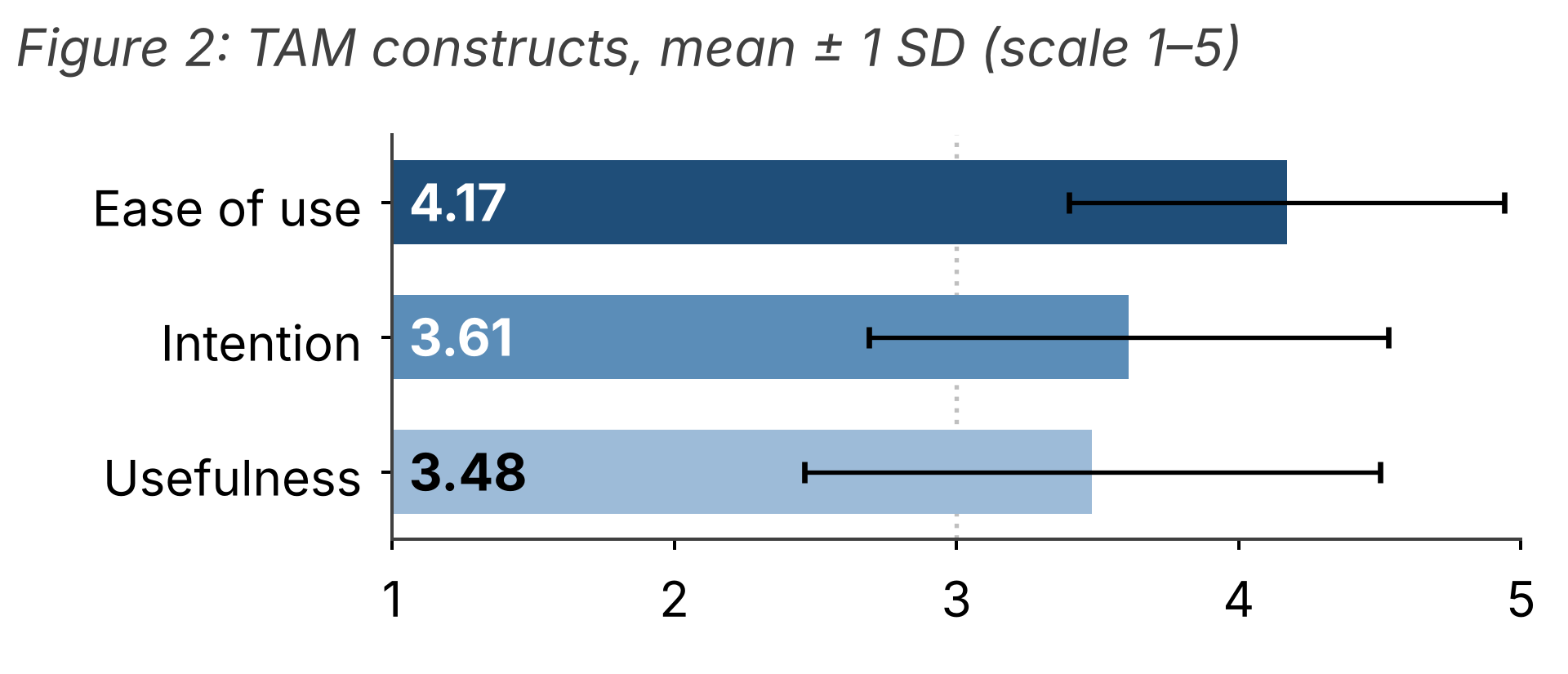 Ease of use was rated highest (M = 4.17), usefulness lowest (M = 3.48; Figure 2), mean SUS was 65.5 (benchmark ≈ 68 [7]). Six participants doubted use during shifts (time, phone rules): the setting, more than the interface, was the concern.
Conclusion
Adaptive support must consider time and social visibility, not only stress level, and allow for no intervention. Given small samples, a working app should next be tested in placements.
References
- Visier-Alfonso et al., Nurse Educ Today, 2024
- Linardon et al., Psychiatry Res, 2025
- Nahum-Shani et al., Ann Behav Med, 2017
- Graneheim & Lundman, Nurse Educ Today, 2004
- Brooke, Usability Eval. in Industry, 1996
- Davis, MIS Quarterly, 1989
- Lewis & Sauro, J Usability Stud, 2018