
Interoperability and digital sovereignty as strategic criteria in hospital information systems procurement processes – recommendations for hospital operators
Aim and Research Question(s)
Hospital Information System (HIS) procurement decisions shape technical architecture, data control, and vendor relationships for many years — yet interoperability and digital sovereignty are rarely assessed through structured, evidence-based criteria before contractual dependencies emerge.This study develops and validates an integrated Multi-Criteria Decision Analysis (MCDA) instrument to support structured HIS procurement.
Objective: To identify, operationalise, and validate interoperability and digital sovereignty criteria within a practical procurement assessment model. This poster presents the technical interoperability strand of the joint thesis.
Background
Interoperability in HIS procurement encompasses exchange standards (FHIR, IHE), clinical data architecture (openEHR), and semantic interoperability (SNOMED CT, LOINC, ICD-10). ELGA provides the current baseline, while the EHDS increases the importance of verifiable interoperability capabilities. Key challenge: Vendor claims of FHIR support are difficult to compare without objective evidence, making declarations alone insufficient for procurement decisions.
Methods
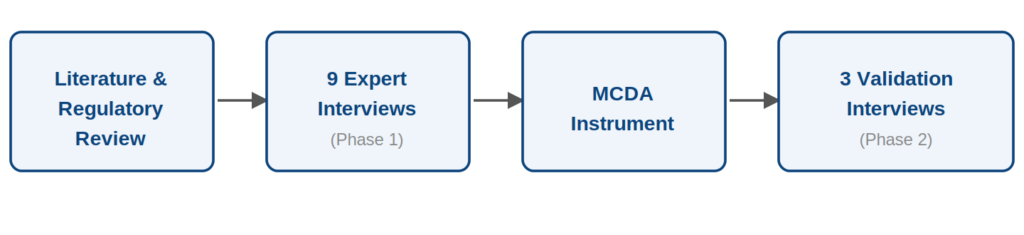
The instrument was developed through a literature review, expert interviews, and practitioner validation. All criteria were assessed against independently verifiable evidence rather than vendor self-declarations.
Results and Discussion
Key findings (Phase 1 interviews, n=9)
- Evidence over declaration: implementation evidence required
- Open APIs dominate: key driver of lock-in
- Clinical data architecture matters: portability is strategic
Resulting interoperability dimensions
- Exchange Standards Conformance (knockout)
- API & Integration Architecture (40%)
- Clinical Data Architecture (45%)
- Semantic & Terminology Interoperability (15%)
Validation: Confirmed by all three Phase 2 participants.
Conclusion
Interoperability should be evaluated through verifiable evidence rather than vendor declarations. Conformance evidence, interoperability testing, and portability requirements should therefore be embedded directly in HIS procurement processes. Clinical data architecture and data portability emerged as the highest-priority interoperability dimensions. This study demonstrates that interoperability can be operationalised as a measurable procurement criterion and evaluated through a practitioner-validated assessment model.
References
- Belton, V. & Stewart, T. (2003). Multiple Criteria Decision Analysis: An Integrated Approach. Springer.
- Mayring, P. (2022). Qualitative Inhaltsanalyse: Grundlagen und Techniken (13th ed.). Beltz.
- Lehne, M., et al. (2019). Why digital medicine depends on interoperability. npj Digital Medicine, 2, 79.