
Concurrent validity of Theia3D markerless motion capture compared to a marker-based system for three-dimensional gait analysis in individuals with Parkinson’s disease
Aim and Research Question(s)
-
Aim: Concurrent validity of Theia3D (markerless) vs. Vicon (marker-based) for 3D gait analysis in Parkinson's disease (PD)
-
RQ1: How well do trunk & lower-limb joint-angle trajectories and spatiotemporal parameters from Theia3D agree with Vicon in PD?
-
RQ2: Is agreement affected by the more- vs. less-affected side?
Background
-
Marker-based motion capture = gold standard, but resource- & time-intensive; markerless systems (Theia3D) estimate kinematics from video → more accessible
-
Good–excellent agreement in healthy adults [1]; 3D validation in PD still lacking [2]
Methods
-
Secondary data from EyeQTrack project (USTP, 2023); n = 14 (Hoehn & Yahr I–III; age 68.6±8.8y; UPDRS-III 19.8±10.4)
-
Overground walking at self-selected speed; simultaneous recording
-
Vicon (22 IR cameras, 55-marker CGM2.5) vs. Theia3D (8 RGB cameras, ~550 gait cycles)
-
36 joint-plane combinations + 30 spatiotemporal parameters; RMSE, Pearson's r, ICC(2,1), Bland-Altman, SPM1D (threshold RMSE > 5°)
Results and Discussion
- Spatiotemporal parameters: excellent validity across all 30 (ICC 0.945-1.000)
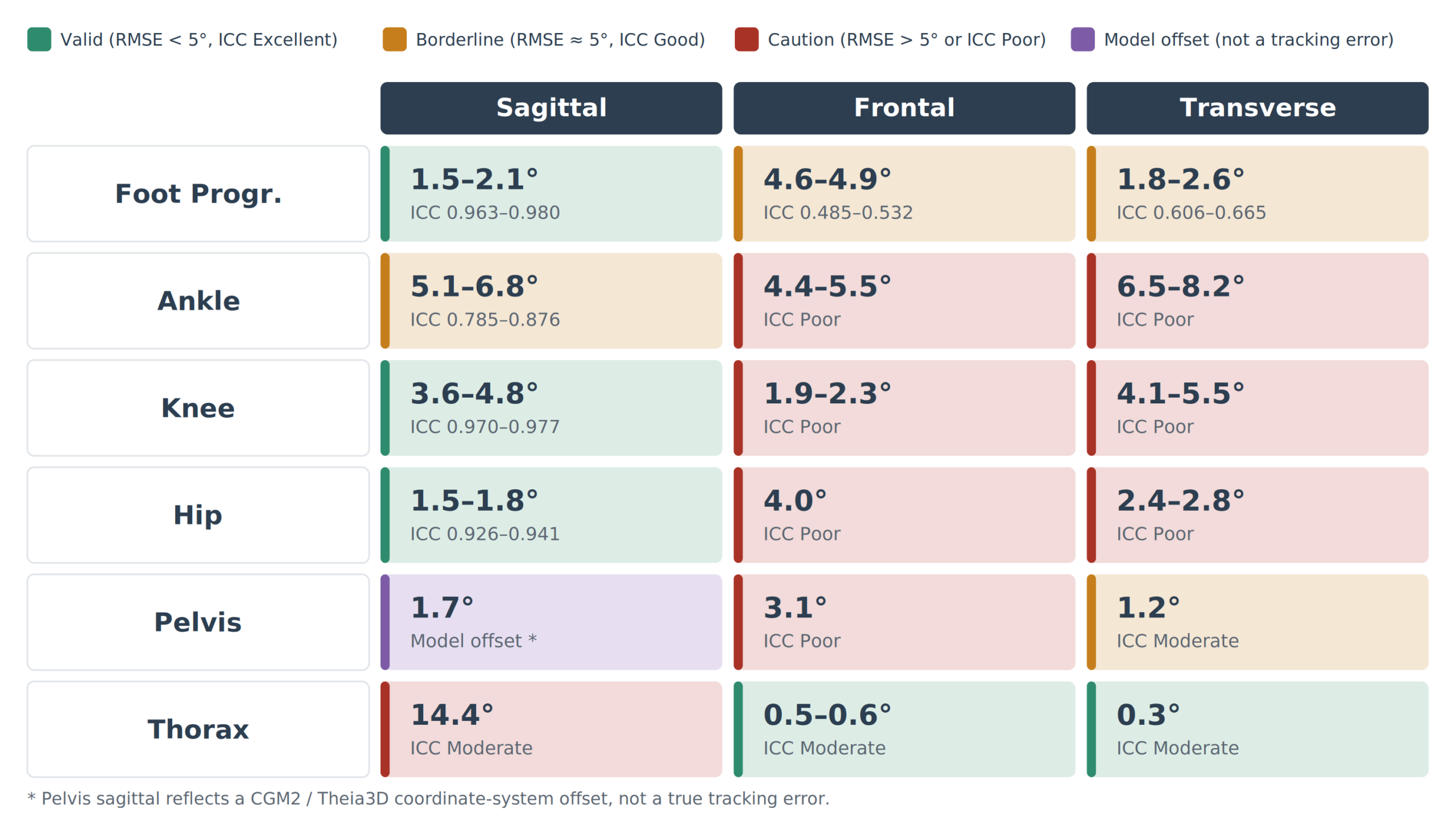
- Kinematics strongly plane-dependent (see matrix): sagittal knee, hip & foot progression excellent (RMSE < 5°); frontal & transverse predominantly poor
- SPM1D: significant differences in 26 of 36 combinations
- Pelvis sagittal = model-level incompatibility (CGM2 vs. Theia3D), not a tracking error [1]
- No consistent effect of motor asymmetry
Conclusion
-
Theia3D = valid, practical alternative for spatiotemporal parameters & sagittal lower-limb kinematics (knee, hip, foot progression)
-
Interpret with caution/not interchangeable: frontal & transverse kinematics, ankle sagittal, pelvis & thorax
-
Findings preliminary → replication in larger PD cohorts warranted
References
[1] Kanko et al. (2021). Journal of Biomechanics, 127, 110665. [2] Seuthe et al. (2025). Journal of Biomechanics, 193, 113008.