
Design and UX – Evaluation of a Micro Stress-Intervention Prototype for Nursing Students: A Qualitative and UX-Testing Approach
Aim and Research Question(s)
This thesis investigates the contextual needs, usability requirements, and acceptance factors of a digital micro-intervention prototype for nursing students during clinical placements.
RQ1: What does current research reveal about digital micro stress interventions
and the contextual, technological, and workflow-related barriers affecting
their adoption in clinical settings? RQ2: What stressors, needs, digital habits, and perceived barriers do nursing students encounter during clinical placements regarding the use of digital
micro stress-intervention tools? RQ3: How do nursing students evaluate the usability, perceived usefulness, and clinical relevance of a prototype digital micro-intervention, as measured
through the SUS and additional descriptive UX and acceptance items?
Background
Nursing stress causes burnout and severe staffing shortages (1, 2). Clinical mHealth tools offer scalable stress management but face adoption barriers like time pressure and lack of privacy. Ultra-short digital micro-interventions (e.g., breathing or grounding exercises) provide a solution (3). These tools require seconds, lower cognitive load, and easily fit fragmented clinical routines.
Methods
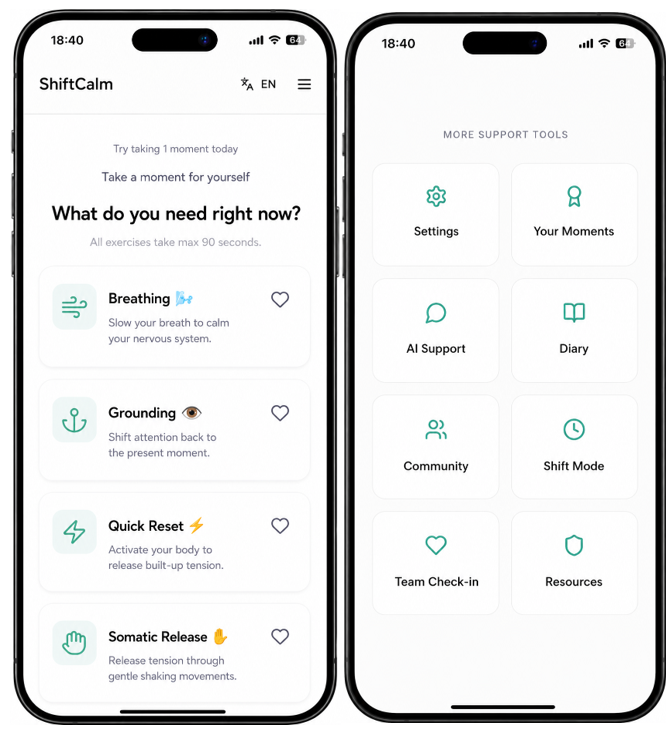
This study used a sequential, human-centered, mixed-method design. First, a needs assessment survey identified workflow barriers among 30 nursing students from two Austrian institutions. Next, the mobile-first clickable Figma prototype "ShiftCalm" was developed. Finally, 15 participants evaluated the prototype using the System Usability Scale (SUS) and qualitative feedback.
Results and Discussion
Most participants (86.6%) preferred interventions lasting under two minutes during shifts. Main barriers are complex layouts, zero privacy, and peer judgment. The "ShiftCalm" prototype achieved an excellent mean SUS score of 83.67, praised for design and interaction. Caught in dynamic workflows, reducing cognitive load remains the primary implementation challenge.
Conclusion
Digital micro-interventions are a promising, low-threshold format for nursing student stress. However, basic usability alone cannot guarantee long-term clinical adoption. Successful real-world implementation requires ultra-short access, absolute visual discretion, complete user autonomy, and the elimination of mandatory login barriers.
References
(1) Jarden, R. J., et al. (2021). Int J Nurs Stud, 124, 103997
(2) Squires, A., et al. (2025). Int Nurs Rev, e13099
(3) Moore, C., et al. (2024). Worldviews Evid Based Nurs, 21(2), 110–119